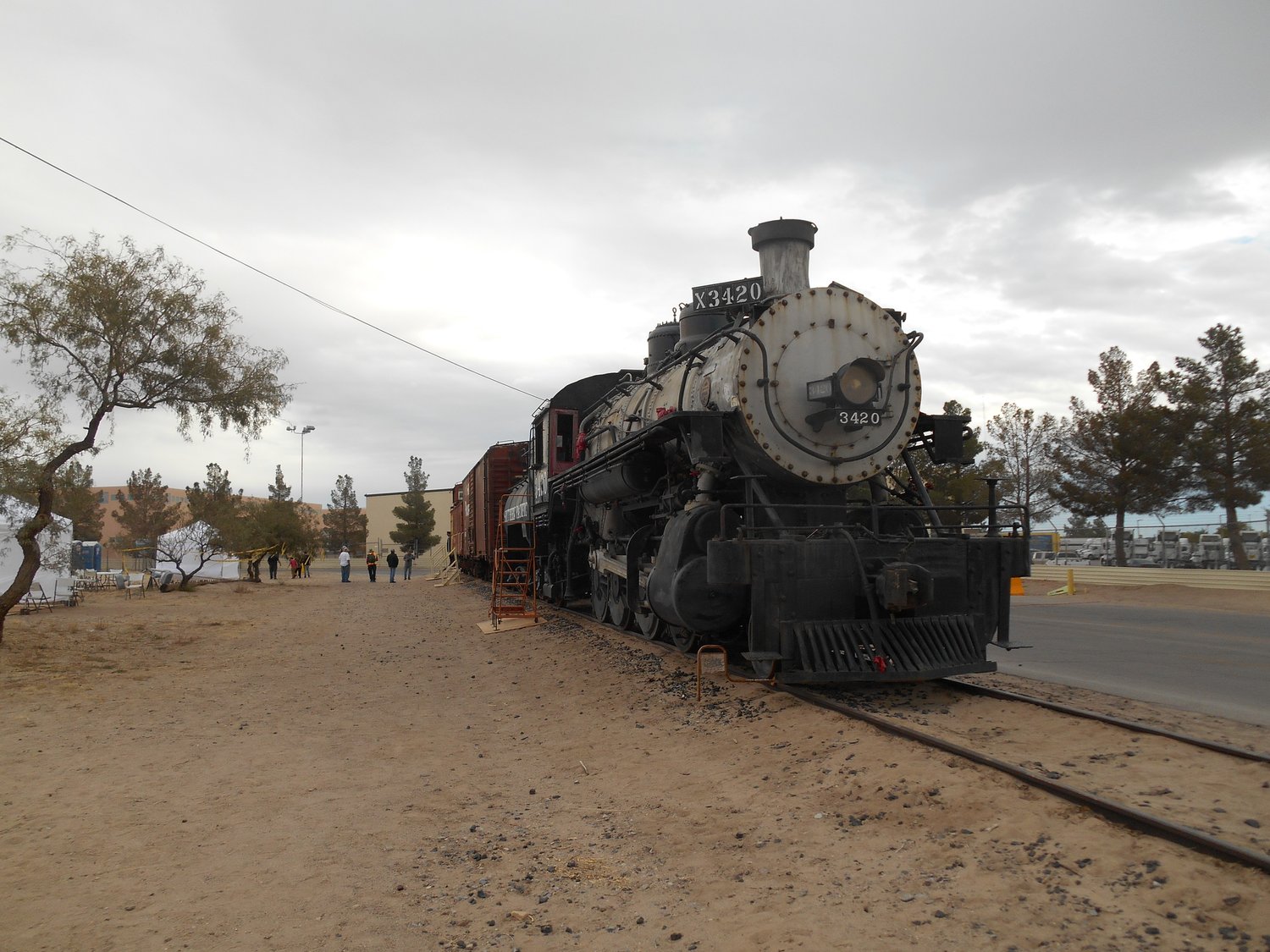
Southern Pacific Coal Burning Locomotive Operations in the Southwest.
Most of the coal in the United States is in the eastern part of the country, this situation resulted in high transportation cost for locomotive fuel for west coast railroads. Considering that railroads make money by carrying the items of others, the railroads would want to limit the amount to internal transportation of locomotive fuel.
The discovery of oil in California and the development of the Kern River Field in the San Joaquin Valley of California and later the discovery of oil field at Beaumont, Texas, created an opportunity for the far western railroads. The Southern Pacific (SP) and the Atchison Topeka & Santa Fe Railway (AT&SF) were leaders in the United States in development of oil burning locomotives. The SP converted their first steam locomotive to burn fuel oil in 1895. In addition to the savings in transportation cost the use of oil also reduced the railroads need for manual labor. When operating coal burning locomotives, you often need to hand shovel coal and the resultant ash various places.
By late February 1902, the SP was actively eliminating the use of coal as a locomotive fuel along its lines. Several communities west of San Antonio and east of El Paso along the Sunset Route were the last to see the construction of fuel oil tanks for locomotive fueling. Once this construction was completed the end the use of coal as a locomotive fuel on the SP came soon thereafter.
The El Paso & Southwestern (EP & SW) was one of the few western railroads with an active coal mine along its line. This was due to the metallurgical process needs of its parent company’s Phelps Dodge Copper Corporation’s operations in southeastern Arizona and the determination of its leadership to secure this coal. Metallurgical grade coal is coal that can be converted into coke which is used in the smelting of copper. The coal from the Dawson Mine was of such consistently that it could be dependably converted to coke which other coal deposits in the western United States were not as easily converted to coke. The coal that supplied metallurgical grade coal for copper operations could also supply the locomotive fuel for the railroad. The EP & SW purchased the El Paso & Northeastern Railway on July 1, 1905.
Technology changes in the processing in copper ore reduced the amount of coal needed in the copper smelting process. Later, the copper smelters to convert their furnaces from coal fuel to oil fuel. The ability to turn coal into coke continued to be an important need for the copper industry as the coke was a part of the purification process.
On November 1, 1924, the SP first leased and eventually purchased the EP & SW. Thus SP once again found itself owning coal burning locomotives. There were several reasons to bring coal fuel back to the SP. Coal burning locomotives could be found on what would become known as the Tucson and Rio Grande Divisions of the SP.
All mainline trains on the EP & SW were powered by coal burning locomotives, from Dawson, New Mexico coal mine, eastward east down the Dawson Branch to the community of Tucumcari, New Mexico, to El Paso, Texas, and then on to Tucson, Arizona via Douglas, Arizona.
After the SP takeover of the EP & SW, the SP installed facilities along the former EP & SW lines to refuel oil burning locomotives. The SP line via Deming, and Lordsburg, New Mexico also saw the construction of several concrete coal towers in 1925 and 1926. With new locomotive fuel facilities in place, the SP began a program of reassigning former EP & SW locomotives to other parts of the SP, converting former EP & SW passenger locomotive power to oil fuel, converting a number of SP 2-10-2s to burn coal for use on the former EP & SW.
Time would reduce the total number of coal burning locomotives found on the SP. By the end of the 1930s the SP used converted coal burning 2-10-2s in mainline service and the 3400 series class C-18, and C-19, 2-8-0s, from the EP & SW, that still used coal for fuel on varied assignments including the Dawson Branch. The United States recovery from the Great Depression in the late 1930s created an increase in traffic on the SP.
The SP made its first purchase of coal burning steam locomotives after 1924. In 1939 the SP purchased a dozen 2-8-8-4 from the Lima Locomotive Works in 1939. These AC-9 were the same power production and size as the most modern power cab forwards on the SP. Their arrival increased the amount of locomotive coal the SP consumed. Their arrival promoted the assignment of two former EP & SW 2-8-2’s SP class MK-9, to the Dawson Branch. In 1940 locomotives numbers SP 3315 and 3320 were once again set up to burn coal. The arrival of the AC-9 also allowed the SP to continue reverting coal burning 2-10-2s back to oil and use the locomotives on other parts of the system.
During WWII, the SP leased over 30 steam locomotives from other railroads. Several of these locomotives were coal burning locomotives that were leased during WWII. El Paso, Texas, was the mechanical home base for these locomotives. Major repairs took place at the old EP & SW shops, by then known as the SP General Shops, on Piedras St. This facility took care of many types of locomotives including both oil and coal fueled locomotives. Lesser repair and maintenance was performed at the various roundhouses along the line.
SP’s second purchase of coal burners occurred during 1945 while World War II still raged.. The SP purchased ten used 2-8-4, locomotives from the Boston & Maine Railroad which became the B-1 class on the SP. The 2-8-4 locomotives were built by Lima Locomotive Works. At the time of the purchase in 1945, the management of the SP expected the war to continue for several more years which influenced the purchase decision. The 2-8-4 were delivered just as the war came to an end.
As late as 1948, the Southern Pacific was developing plans to invest in new coal handling facilities as the motive power plan called for the use of coal powered steam locomotives for another 10-years. In 1950 a two-year agreement between the SP and Phelps Dodge to supply the coal was signed only to have continued labor unrest, at the Dawson, prompt Phelps Dodge to close the mine and eliminate the company town.
The sudden announcement of the closure of the mine caused the SP to begin to convert all of the remaining coal burning B-1 class locomotives and AC-9 locomotives to the use of oil fuel. With the conversion of the road locomotives to oil fuel, SP proceeded to abandon coaling towers along the line to reduce the railroads tax bill. While the initial wording of the request for the Alamogordo, New Mexico coaling tower was not repeated, the wording gives us an insight into the initial thought of some employees of the SP.
“Because of the recent cessation of all coal mining operation at Dawson, the use of coal for locomotive fuel has been discontinued. There is no present or future need for coal facilities.
The coal chute at Alamogordo is a timber structure built in 1924. The coal track total 1779 ft. in length. It is proposed to retire and remove these facilities which are no longer of use.
Early authority is requested”
Latter wording would state similar wording to the following:
“The Coal Chute, Coal hopper track, cinder incline, and cinder depressed track at Deming, New Mexico on the North Line have become obsolete and unneeded with the introduction of diesel power and subsequent discontinuance of coal burning locomotives.
This change in type of power being used on this line, with resultant removal of coal for fuel, make it necessary to retire the facilities, which were installed primary for coal usage, so that room may be made available for future developments and unnecessary facilities retired.
It is recommended that these facilities be retired and removed with the exception of the coal chute which, being constructed of reinforced concrete will be retired, stripped of all salvable material and abandoned in place as removal cost would be prohibitive.
Early Approval of these retirements is hereby requested.”
The last four locomotives converted from the use of coal to oil in order were SP 3400 on October 18, 1950, SP 3409 on November 10, 1950, SP 3410 on December 11, 1950, and the last locomotive was SP 3420 on April 26, 1951. The work on the conversion of SP 3420 took place after a fire occurred in the El Paso coaling tower on March 22, 1951.
This story is a part of the unique history of 3420 and the Southern Pacific that no other preserved locomotive played a part.
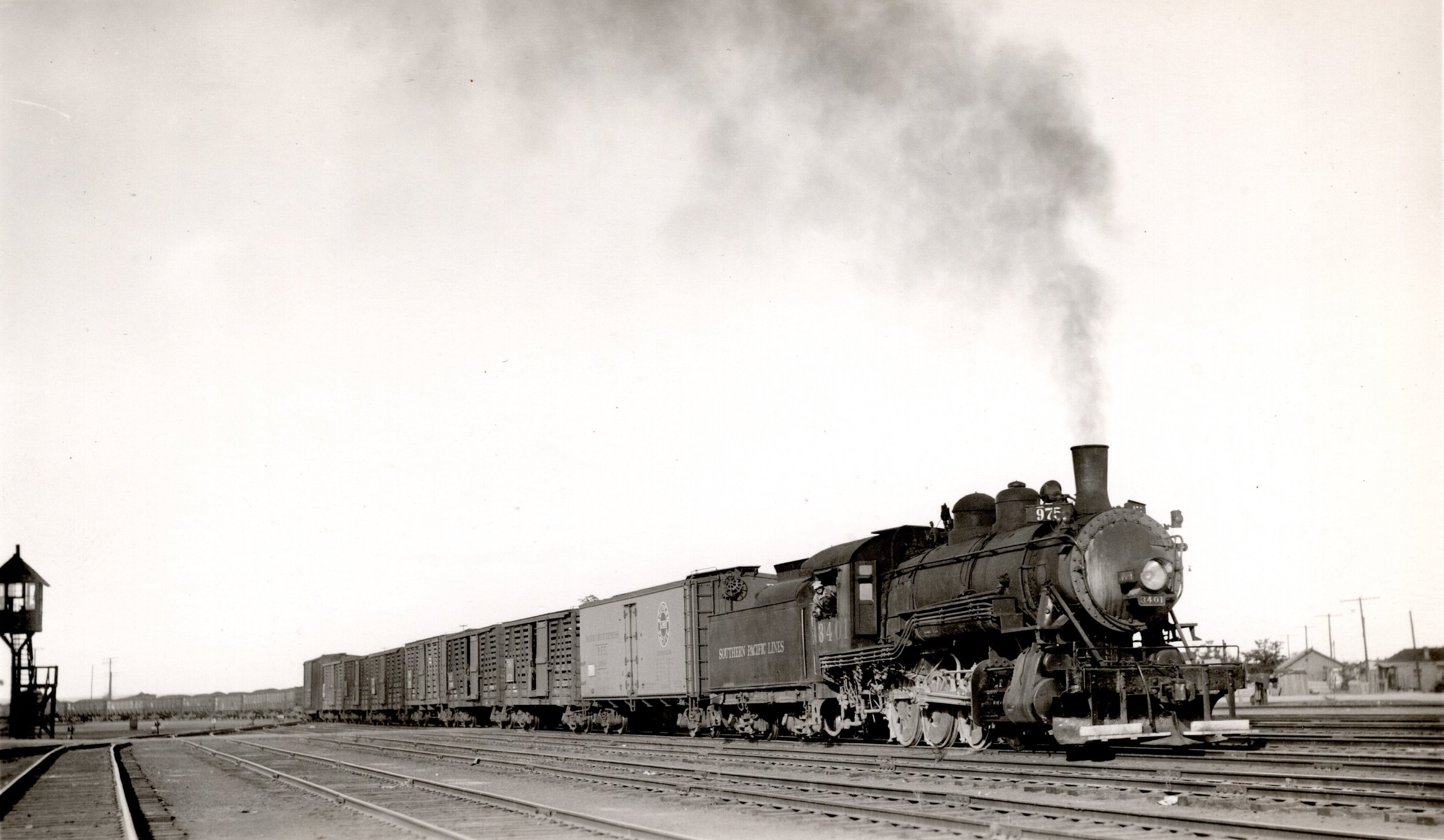
Southern Pacific 3401 with the train 975 entering the yard at Tucumcari, New Mexico. SP 3401, a C-18 class 2-8-0, is returning from Dawson , New Mexico. There are plenty of details to note in this photo. The pilot plow behind the footboards is of interest. This image shows a lot of sand on the second, third, and fourth set of drivers. Also note the tender modified tender constructed by the EP&SW for service on the Dawson Branch. Photographer unknown. Robby Peartree Collection.
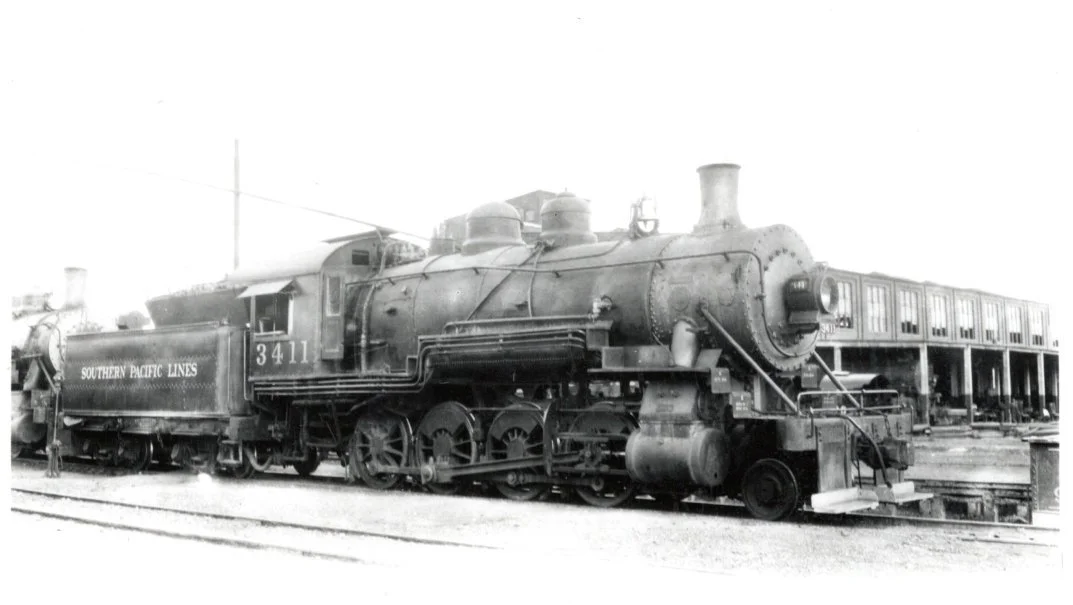
This engineer’s view of Southern Pacific 3411 illustrates several details of the C-19 class 2-8-0 and the back shop area of the El Paso’s shop. The 3411 received this type of valve assembly when the locomotive was superheated in El Paso by the EP&SW as their #162. Notice the difference in the layout of the running boards from cab to pilot. The narrow coal bunker to help with visibility of the engineer over the tender. Also notice the visible activity at the back shop. What we can see is the front end of one locomotive and a locomotive cab. Photographer unknown. Robby Peartree Collection.

This view of Southern Pacific 3411, a 2-8-0 C-19 class taken behind the El Paso roundhouse This view of the fireman’s side of SP 3411 does provide us with some opportunity to see some of the changes the locomotive received over the years between the two photos. These changes include the cylinder castings, the running boards were moved, and a different tender was installed by this date. Photographer unknown. Robby Peartree Collection.
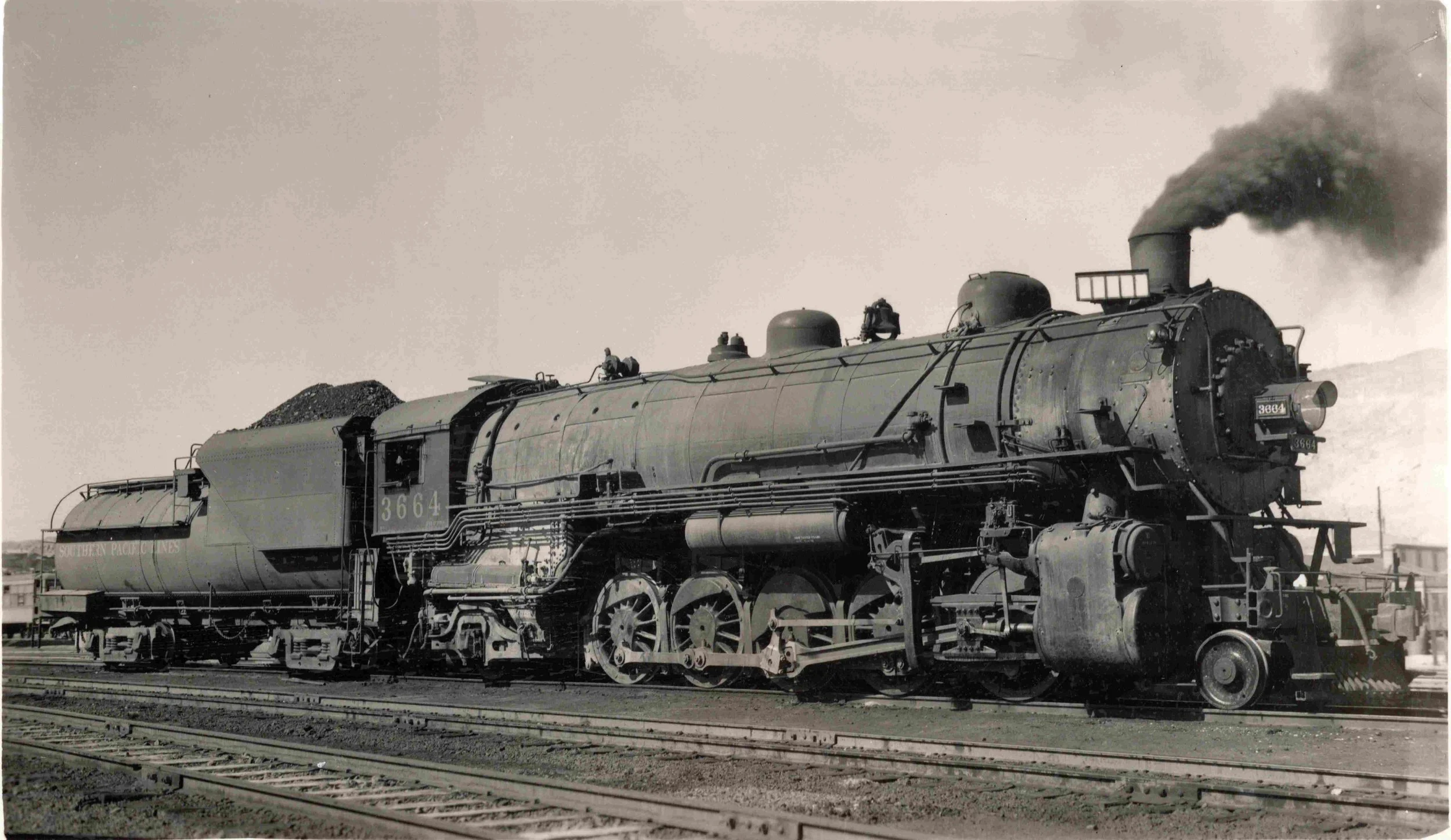
This photographic image taken at El Paso shows the engineer’s side of Southern Pacific 2-10-2 F-3 class 3664. Southern Pacific 2-10-2 3664 was converted to burn coal after the takeover of the El Paso & Southwestern. This image is of interest to Robby Peartree due to the pictured main rod. I would like to know more about the design of the main rod. by the late 1930s the SP would have only 2-8-0s and 2-10-2s that used coal for fuel. The arrival of the AC-9 was the first significant addition to the coal burning roster since the conversion of the 2-10-2s.. Photographer unknown. Robby Peartree Collection.
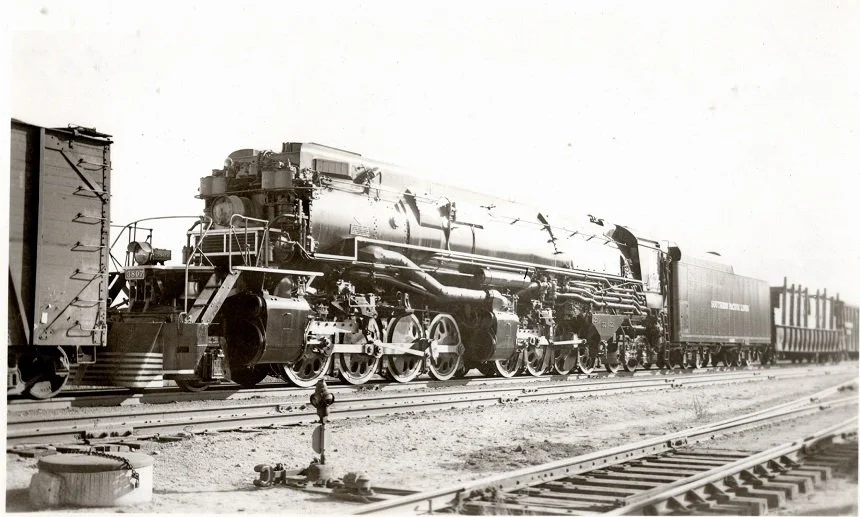
Here we see the Fireman’s side of Southern Pacific 2-8-8-4, AC-9 Class, #3807 while the locomotive was enroute from the factory to El Paso for delivery for set up for the SP. In the cab you can see the factory messenger sent to ensure the safe shipment of the locomotive. The messenger ensured the lubrication of the locomotive and the proper train speeds and other train handling to protect the shipment. The drum in front of the smokebox provides additional lubrication oil capacity for the transportation of the locomotive. The four missing main rods were stored on the tender. Photographer unknown probably D. N. Eldridge. Robby Peartree Collection
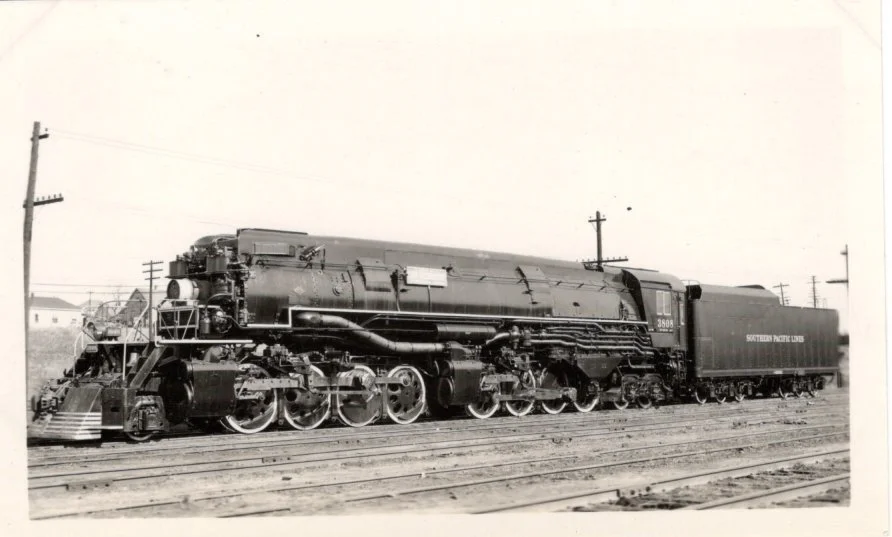
Here is a view of Southern Pacific 2-8-8-4 AC-9 class #3808 set out in Kansas City, Kansas. The locomotive was enroute from the factory to El Paso for delivery for set up for the SP at El Paso. This angle gives us a better view of the sign along the running board for the Lima Locomotive Works. Photographer unknown probably D. N. Eldridge. Robby Peartree Collection..

Southern Pacific 2-8-8-4 AC-9 class #3804 was photographed at Tucumcari, New Mexico while the locomotive was taking on sand in the sand dome. Two men are seen standing on the boiler and one is at the engineer’s position. SP 3804 would be spotted or moved several times to complete this servicing. Photographer unknown Robby Peartree Collection.
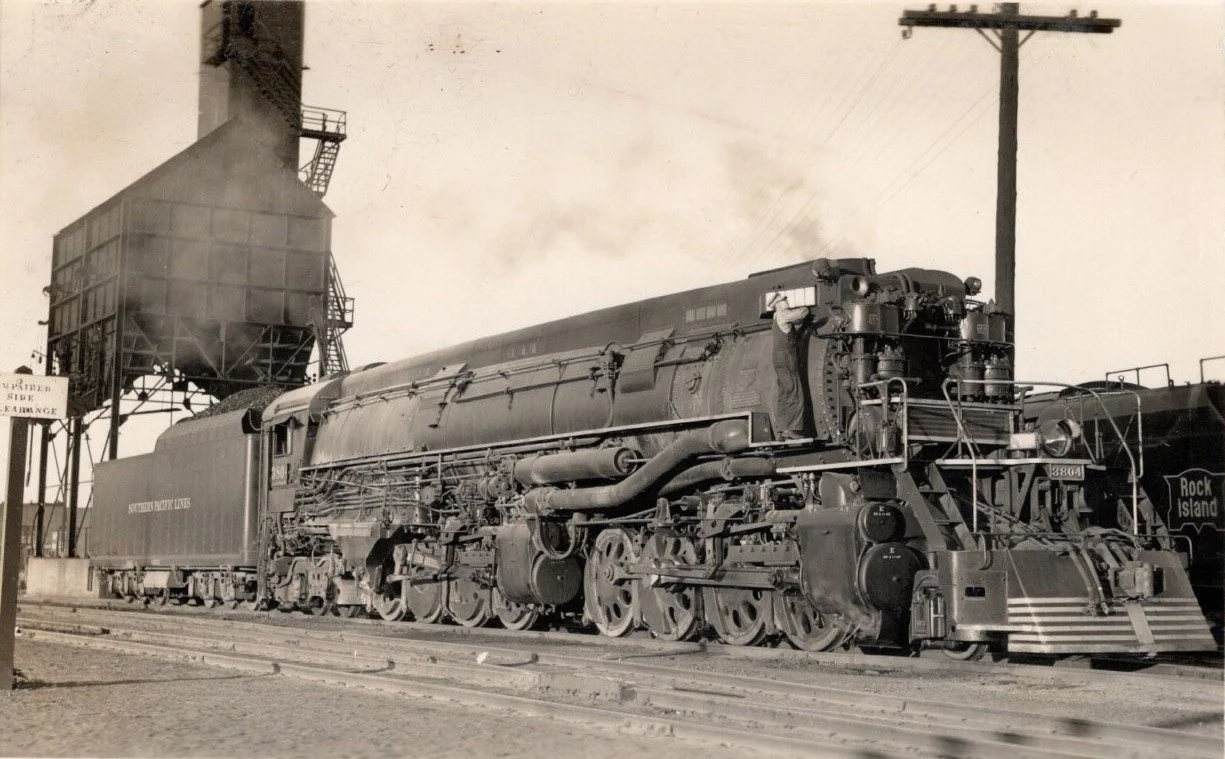
Here we see Southern Pacific 2-8-8-4 AC-9 class #3804 spotted to a new position for servicing at Tucumcari, New Mexico. By having the locomotives move from station to station you reduced the amount of specialized facilities required to service locomotives at a given location. Notice the employee on the running board is working on the marker light. Also note the Rock Island locomotive tender behind the SP 3804. Photographer Unknown Robby Peartree Collection
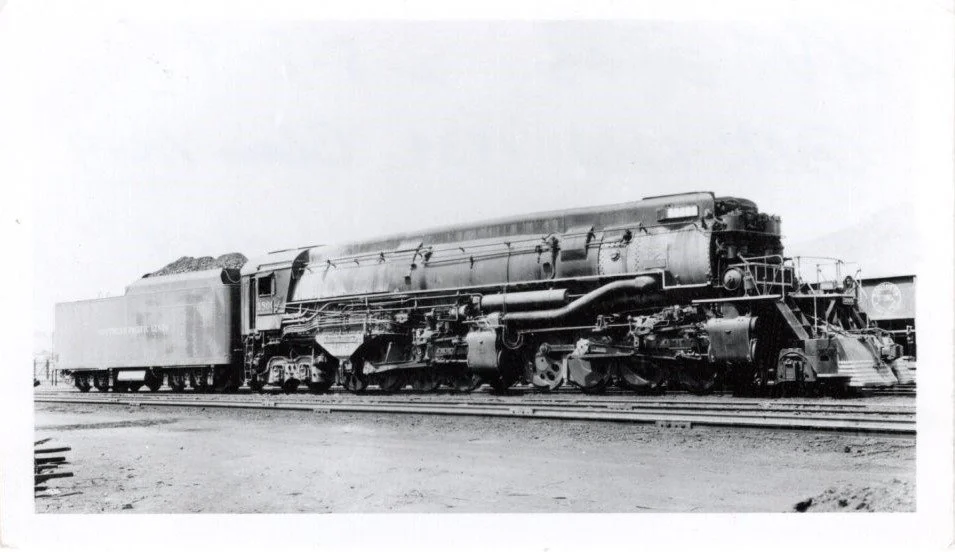
Southern Pacific AC-9 3800 at El Paso.
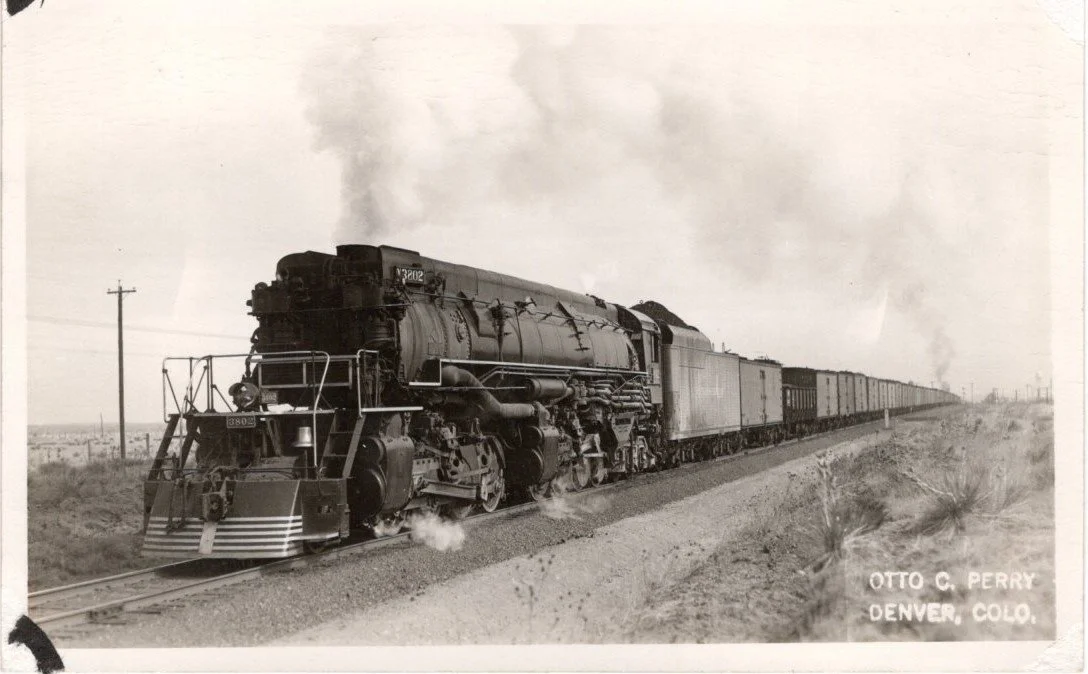
Otto Perry of Denver Colorado would make many trips photographing steam locomotives in the west. Otto made trips to several trips El Paso, Texas during his life. Here we see Southern Pacific 2-8-8-4 Class AC-9 3802 Leaving Tucumcari New Mexico with a Freight Train. Today Otto Perry photographs reside at the Dever Public Library. Your editor purchased a copy of this post card from a seller on eBay. Robby Peartree Collection
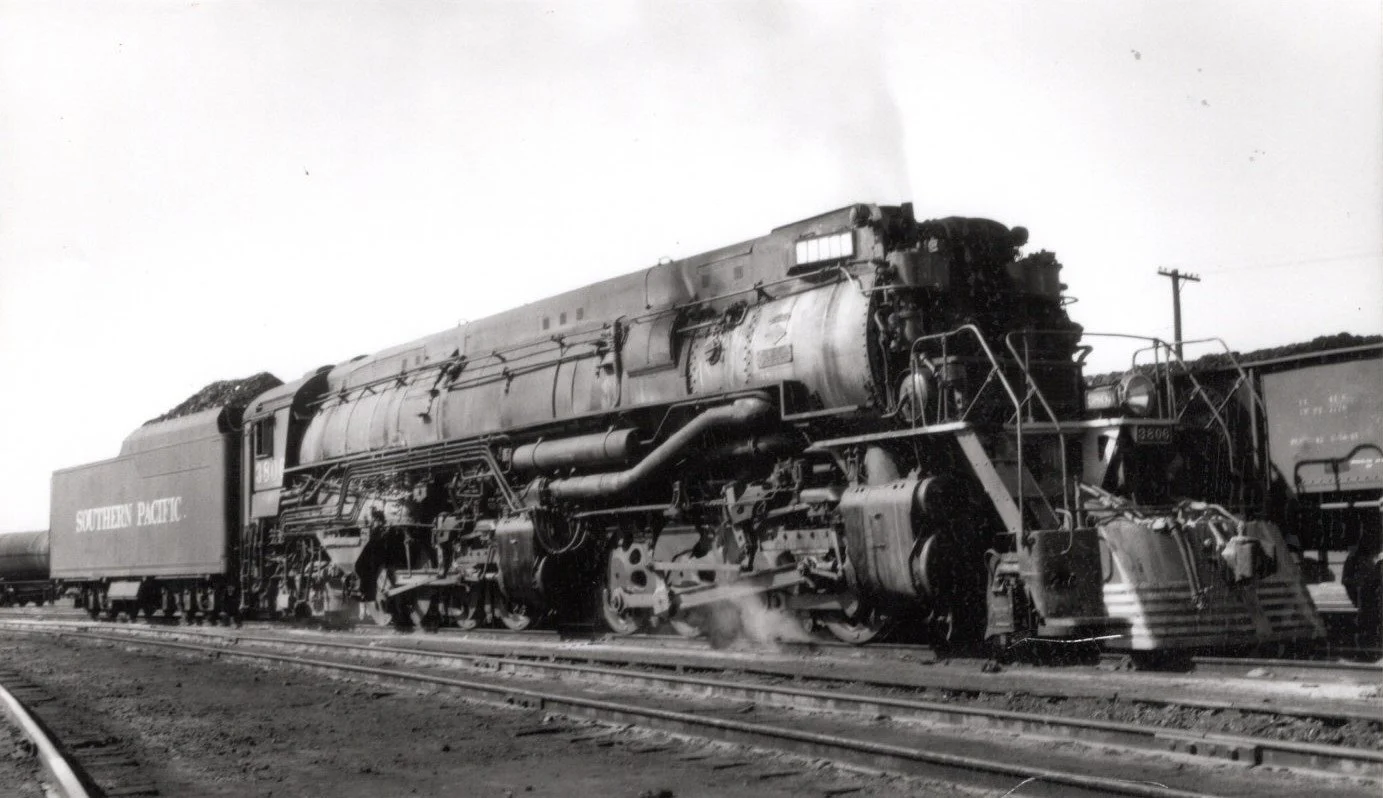
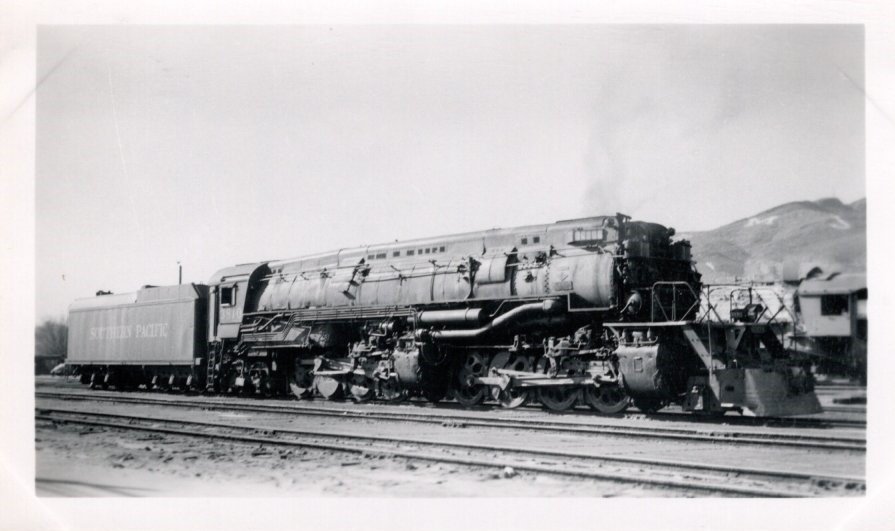
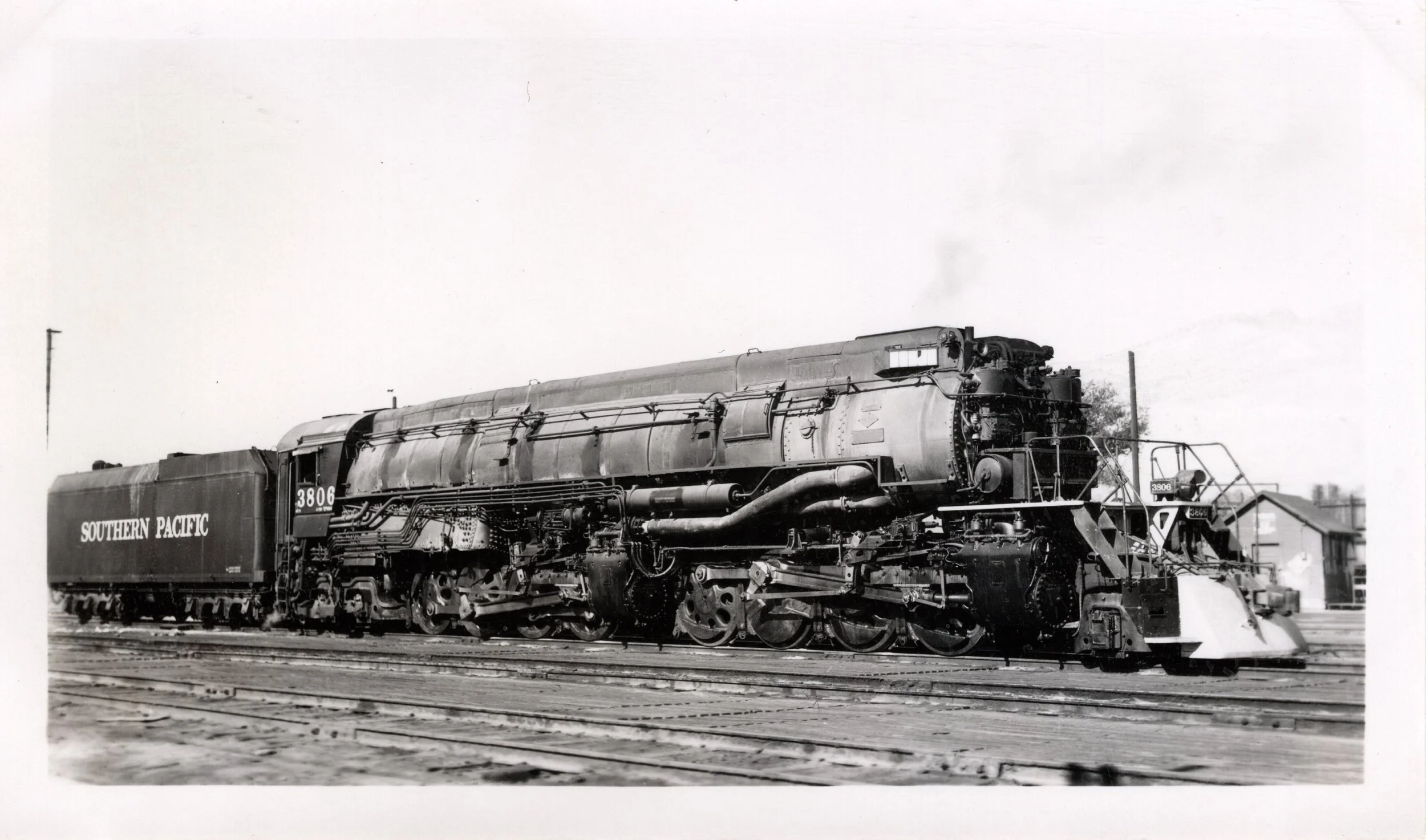
Southern Pacific class AC-9 #3806 a 2-8-8-4 at El Paso Piedras St. Shops on 12-2-47. Photo by John Grober
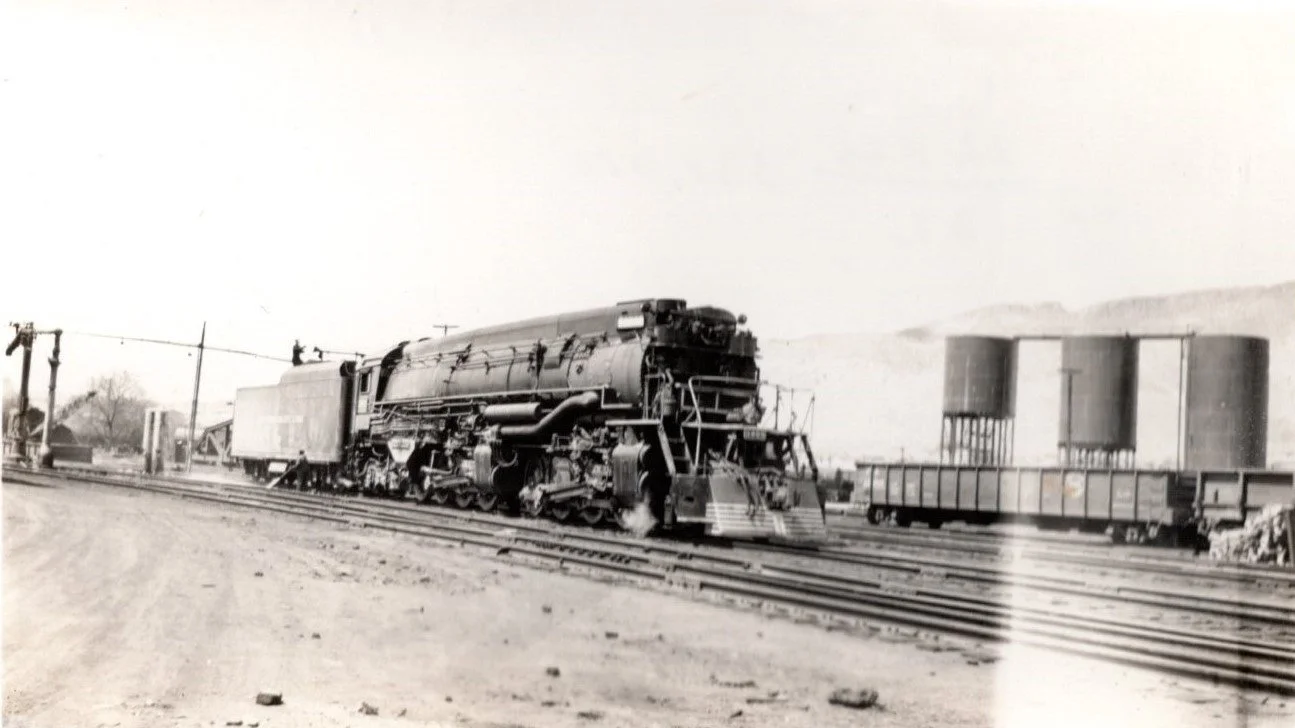
Southern Pacific class AC-9 #3805 a 2-8-8-4 being serviced at El Paso.
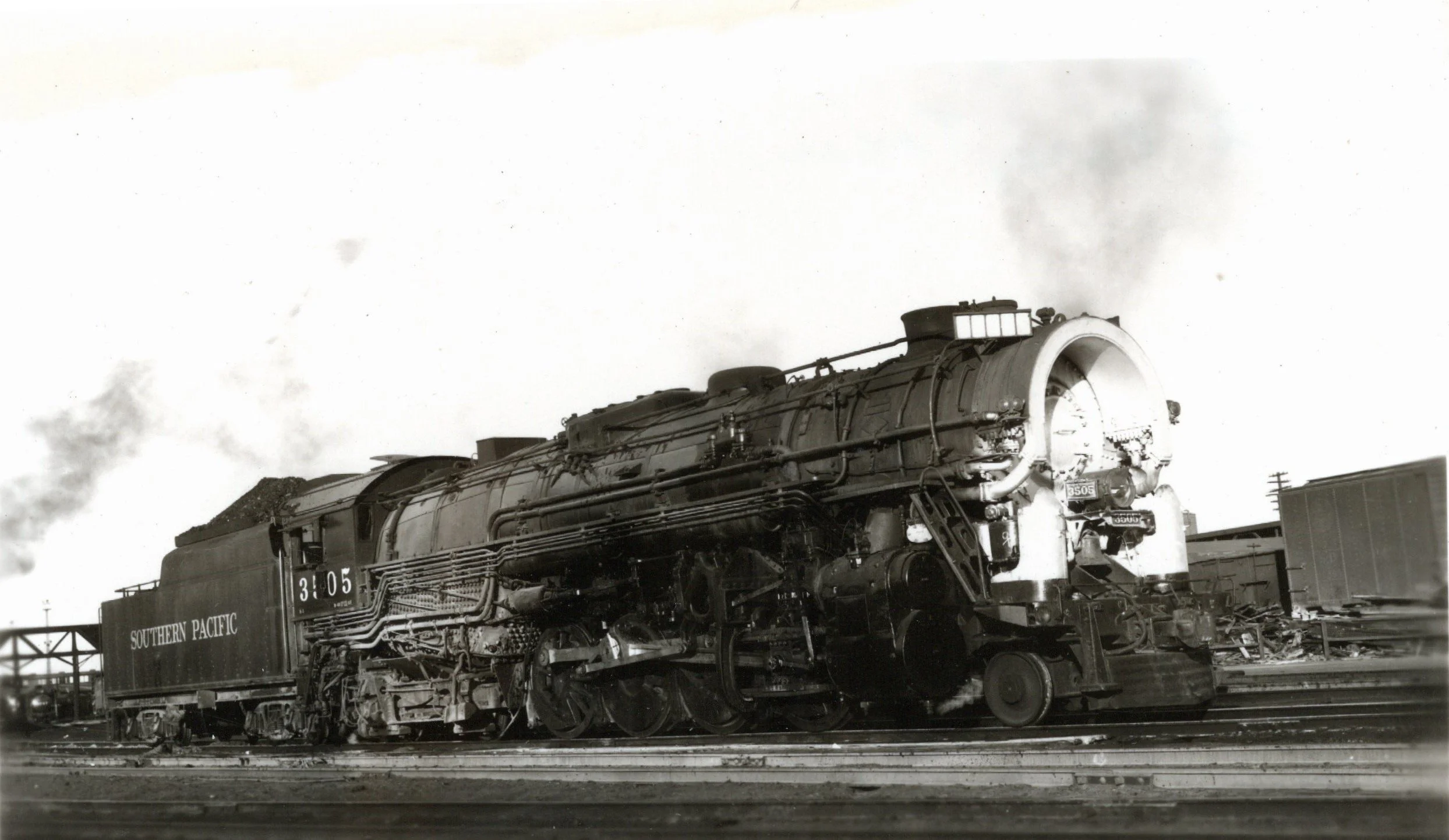
Southern Pacific class B-1 #3505 2-8-4 "Berksire" at the SP General Shops on Piedas St in El Paso .

Southern Pacific class B-1 2-8-4 # 3506 at the coaling tower at El Paso Texas.
Quick notes on other railroads
Until the end of steam locomotive operations for the AT&SF in New Mexico, the AT&SF operated both oil and coal fired locomotives. Coal for the Santa Fe came from mines in the Gallup, New Mexico area and the Raton Pass area. The distance to El Paso, Texas, and the labor savings probably made the choice for management of oil fuel on the line to El Paso.
As late as World War I, the Texas & Pacific (T&P) operated coal fired locomotives into El Paso. By the end of steam on the T&P, the railroad was known for using oil for locomotive fuel.